Case Study · Agentic AI · Self-Initiated · 2026
Knowledge Companion Agent
A multi-agent service blueprint for a regulated fintech's wealth-publication workflow. Four AI agents working in concert, with compliance as a first-class peer — not a final gate.
The fast read
- Self-initiated proposal. Designed, scoped, and pitched the whole thing.
- Four AI agents working in concert: Insight Synthesizer → Content Architect → Compliance Validator → Design Composer.
- Service blueprint with full frontstage / backstage / line of visibility — not a pipeline diagram, a designed service.
- Compliance treated as a first-class peer agent, not a final gate. A real design move for regulated AI workflows.
- Pitched to leadership at the consultancy; became a live client conversation.
Context
The workflow that was breaking
A regulated fintech publishes a monthly market-outlook piece for its high-net-worth clients. The workflow is brittle by design: a Wealth Strategist submits the topic, a Marketing Editor drafts, compliance reviews, a designer lays out, and only then does the piece ship. Multiple humans, multiple weeks per cycle, and compliance is always the slowest, most error-prone step.
The interesting question wasn't "can we use AI to write the post" — every vendor was pitching that. The interesting question was: can we keep the regulatory rigor of the workflow while compressing the time-to-publish, and not replace the humans where their judgment actually matters?
The problem
Three sides of the same brief
For the Wealth Strategist
"I have a topic. I need to publish a defensible monthly piece that surfaces credible market signals — without writing it from a blank page every month."
For the Marketing Editor
"Compliance review blocks every cycle. Either we find a way to validate as we go, or we keep missing publication windows."
For the design
"Design a service that uses AI without removing the human-in-the-loop where it matters most — compliance, editorial judgment, and the final sign-off."
My role
Self-initiated, end-to-end
This wasn't a client brief. I came up with the idea, designed the service blueprint, scoped the agentic architecture, defined the human-in-the-loop checkpoints, drafted the input/output contracts for each agent, and pitched the whole thing to leadership at the consultancy.
The pitch became a live conversation with the client. The blueprint below is the artefact that did the talking.
Approach
Reframe before you build
Most "AI for content workflows" pitches in 2026 are pipelines: topic in, polished post out. Pipelines are wrong for regulated work because they hide the moments where human judgment is non-negotiable.
I started from the existing service — humans, handoffs, feedback rounds — and asked, agent by agent: what is this person doing today that AI can do faster without losing the reason they were doing it? Four agents fell out naturally, one per major task:
- Insight Synthesizer — pulls data, scores credibility, returns a structured brief.
- Content Architect — drafts the post from the brief in the brand's tone.
- Compliance Validator — runs in parallel, flags risky predictions, suggests compliant phrasing.
- Design Composer — lays out the published artefact with charts, branded template, ready to ship.
The service blueprint is the spine. Without it, you have four chatbots. With it, you have a workflow.
Key decisions
Four decisions that shaped the design
Decision 01
Compliance as a peer agent, not a gate
Most LLM workflows put compliance review at the end. For a regulated domain that's wrong — it means every iteration risks failing the final check, which means publication slips. We promoted the Compliance Validator to a peer agent that runs alongside the Content Architect, scanning every draft in real time and suggesting compliant phrasing inline. The cost is more agent runs per cycle; the benefit is no end-stage surprise.
Decision 02
Schema-bound outputs at every agent boundary
The temptation was to let each agent return free-form text and chain them. We rejected that for the same reason VEDA rejected free-form prompts: schema-bound outputs are auditable, comparable, and recoverable when an agent gets it wrong. Each agent produces a named, structured artefact — Insight Brief, Compliance Report, Tone & Culture Report — and the next agent consumes that artefact, not text.
Decision 03
Human checkpoints at meaningful moments only
AI doesn't replace judgment — it accelerates the steps between judgment moments. The blueprint keeps humans in the loop at three points: topic submission, post-draft feedback, and final compliance verification. Between those moments, the agents work autonomously. The Wealth Strategist isn't approving prose; they're approving the editorial direction.
Decision 04
Loop, not pipeline
The blueprint isn't linear. Every feedback round re-triggers the Content Architect and the Compliance Validator together; every compliance flag re-triggers a draft revision. We modelled this as a loop with explicit re-entry points, not a pipeline that ran end-to-end. AI workflows in regulated domains have to handle iteration as a first-class case, not as an exception.
01 / 04
Selected artifact
The blueprint itself
The diagram below is the actual artefact I pitched. It's a full service blueprint — service journey across the top, evidence and time below, then human roles, agent roles, and each step's I/O contract laid out cell by cell.
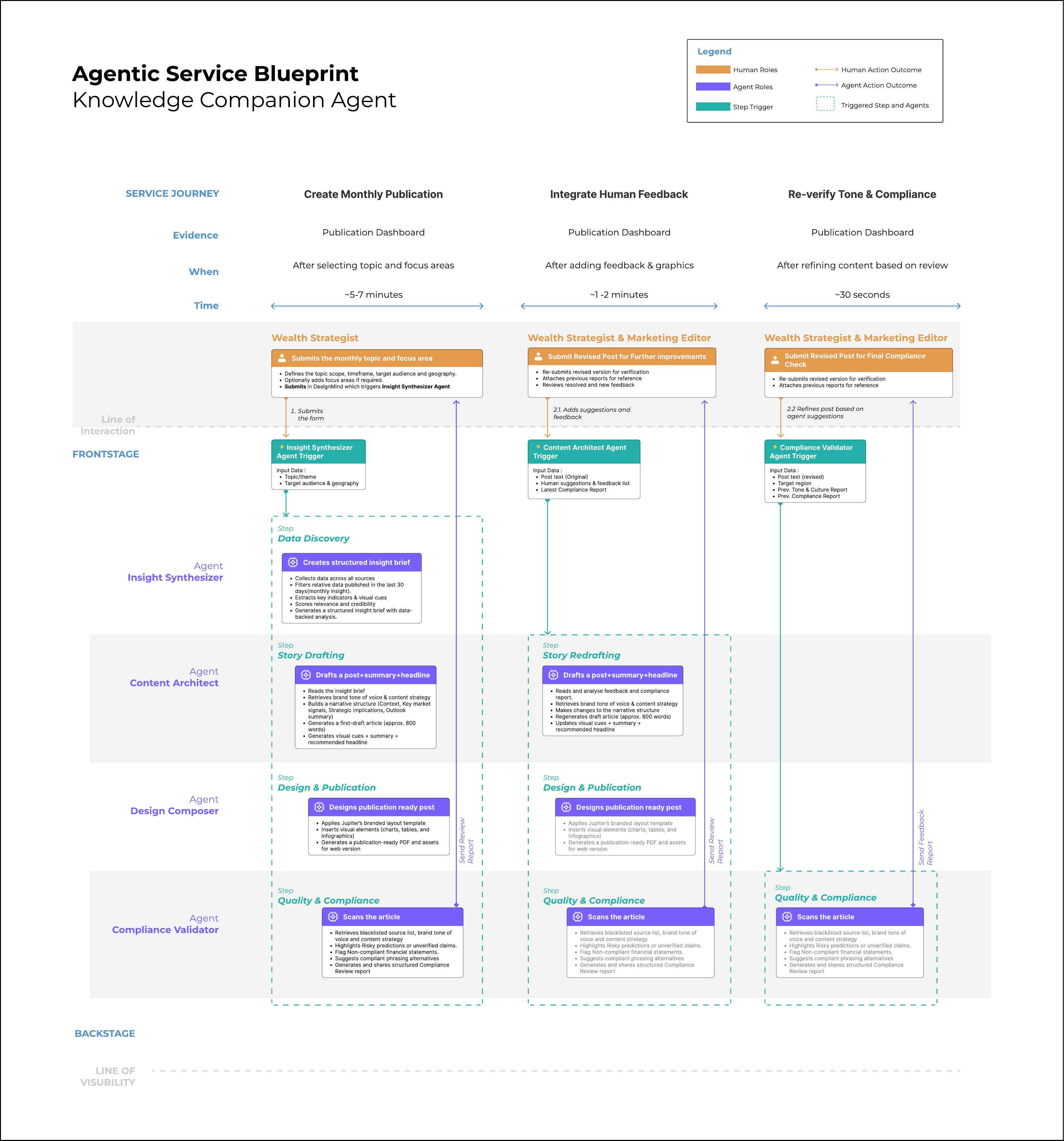
Figure 1
The full service blueprint — three service phases (Create Monthly Publication, Integrate Human Feedback, Re-verify Tone & Compliance), four agents, and the explicit handoff contracts between them. The Line of Visibility separates the human-facing surface from the agent-driven backstage.
Outcome
From idea to client conversation
- Pitched the blueprint to leadership at the consultancy.
- The pitch became a live conversation with the fintech client.
- The blueprint became reference architecture for similar regulated-workflow engagements.
- Confirmed that the more useful design move in agentic AI is the service around the agents, not the agents themselves.
Reflection
"The interesting design problem in agentic AI isn't the agents — it's the service blueprint around them. Where do humans stay? What's the handoff contract? Who owns failure when the AI is wrong? Old service-design questions, new actors at the table."
What I'd carry into the next one of these: prototype the loop earlier. The first draft of the blueprint was a pipeline — the loop structure only became obvious after a few rounds of walking through real-world feedback scenarios. The way humans actually use a workflow is rarely the way the workflow looks on paper.